

5 Ways to Catch Medical Device Software Defects Before They Become Costly Problems
Medical device software development doesn’t end when the product works—or even when the device receives FDA clearance.
Some of the most expensive problems appear much later, when a product is transferred to manufacturing, deployed at a customer site, or already being used in the field.
There is a concept I often refer to as defect injection and detection. The goal is simple: when a defect is introduced into a product, you want to detect it as close to that point as possible.
A defect introduced during development but discovered in the field may require a team to go all the way back to the original design, determine root cause, update the software, perform testing, update documentation, and potentially address devices already deployed to customers.
The larger the gap between defect injection and defect detection, the greater the potential cost.
Here are five areas medical device and Software as a Medical Device (SaMD) teams should consider to help close that gap.
1. Think About Deployment Before You Are Ready to Deploy
Software teams sometimes treat deployment as something they can figure out after development.
For medical device software, deployment needs to be considered much earlier.
How will the software be built? How will it be installed? How will it be maintained? How will upgrades be performed? And, importantly, are you testing the product in a way that represents how it will actually be deployed and used?
These questions can affect the design of the product itself.
FDA expectations have also evolved. Software deployment, upgrade mechanisms, maintenance, and cybersecurity considerations are increasingly important elements of the overall software lifecycle and submission documentation.
Waiting until the end of development to answer these questions can uncover problems at exactly the wrong time.
Design for deployment—not just development.
2. Use Both Top-Down Risk Analysis and Bottom-Up DFMEA
Risk management is essential to medical device development, but teams should be careful not to look at risk only from the system level.
Many unexpected failures occur at the subsystem level or where two subsystems interact.
For example, a problem may appear to be a software defect when the real cause is an electromechanical condition the software was never designed to recognize. Software might expect a signal to be either high or low—but what happens if there is no signal at all?
If that failure mode was never anticipated, it may not be properly addressed in the requirements, software design, or testing.
This is where a strong Design Failure Mode and Effects Analysis (DFMEA) can provide significant value.
Top-down risk analysis helps teams understand system hazards. A bottom-up DFMEA forces the team to examine how individual components and subsystems can fail—and what happens when they do.
Using both approaches can expose failure modes that otherwise may not be discovered until the product reaches the field.
3. Invest in Unit Testing and Software Documentation
Finding a software defect is one thing.
Finding its root cause can be much more difficult.
A field issue may depend on a particular combination of user behavior, patient interaction, hardware state, software state, or environmental conditions. Trying to physically recreate every one of those variables can make troubleshooting extremely difficult.
Unit testing gives engineering teams another way to approach the problem.
With appropriate unit tests, engineers can simulate software inputs and isolate behavior without having to reproduce the entire physical environment.
Good software documentation is equally important.
When a high-risk field issue occurs, your engineering team needs to understand not only what the software does, but why particular design and implementation decisions were made.
Doing less documentation or testing upstream may save time during development. But if a serious issue occurs later, that technical debt can make root-cause analysis significantly more difficult.
You can pay now—or pay later.
4. Design Software With the Field in Mind
Medical devices can remain in use much longer than teams initially anticipate.
That makes software and firmware upgradeability an important business consideration—not simply a technical one.
Imagine discovering a high-risk software issue after hundreds, thousands, or tens of thousands of devices have been deployed.
If those devices can be securely upgraded or patched, the manufacturer has options.
If they cannot, correcting the problem may require physical intervention or potentially replacing or recalling devices.
There are products where replacement may make business sense, particularly disposable or limited-use devices. But for products expected to remain in the field for years, lack of upgradeability can create significant downstream risk.
A successful product means your installed base may become much larger than anticipated.
Design accordingly.
5. Feed Post-Market Complaints Back Into Product Development
A customer complaint shouldn’t simply be treated as a fire that needs to be extinguished.
It is also data.
When complaints occur, teams should look for patterns and understand root cause. Is the issue related to the product? Manufacturing? The development process? Tools? Training? Usability? Or an unexpected way customers are interacting with the device?
Frequency matters. Severity matters. Patient safety matters.
But even lower-risk issues can affect customers’ perception of product quality.
Post-market information should therefore make its way back into R&D, risk management, design controls, and future product versions.
This feedback loop can be relatively easy in a small company where teams work closely together. In larger organizations, complaint handling, field service, quality, and R&D may operate independently.
Those organizational barriers shouldn’t prevent engineering teams from learning what is actually happening to their products in the field.
The strongest medical device development organizations don’t just correct individual complaints.
They use those complaints to improve how the next product is designed.
Close the Gap Between Detection and Injection
You cannot assume that a medical device will never experience a defect.
What you can control is how your development processes help you anticipate, detect, diagnose, and correct those defects.
Think about deployment early. Use top-down and bottom-up risk analysis. Build strong unit testing and documentation. Design for field maintenance. And create a feedback loop between post-market experience and R&D.
The objective is to continuously shorten the distance between when a problem is introduced and when it is discovered.
Because the earlier you find it, the more options you have to fix it.
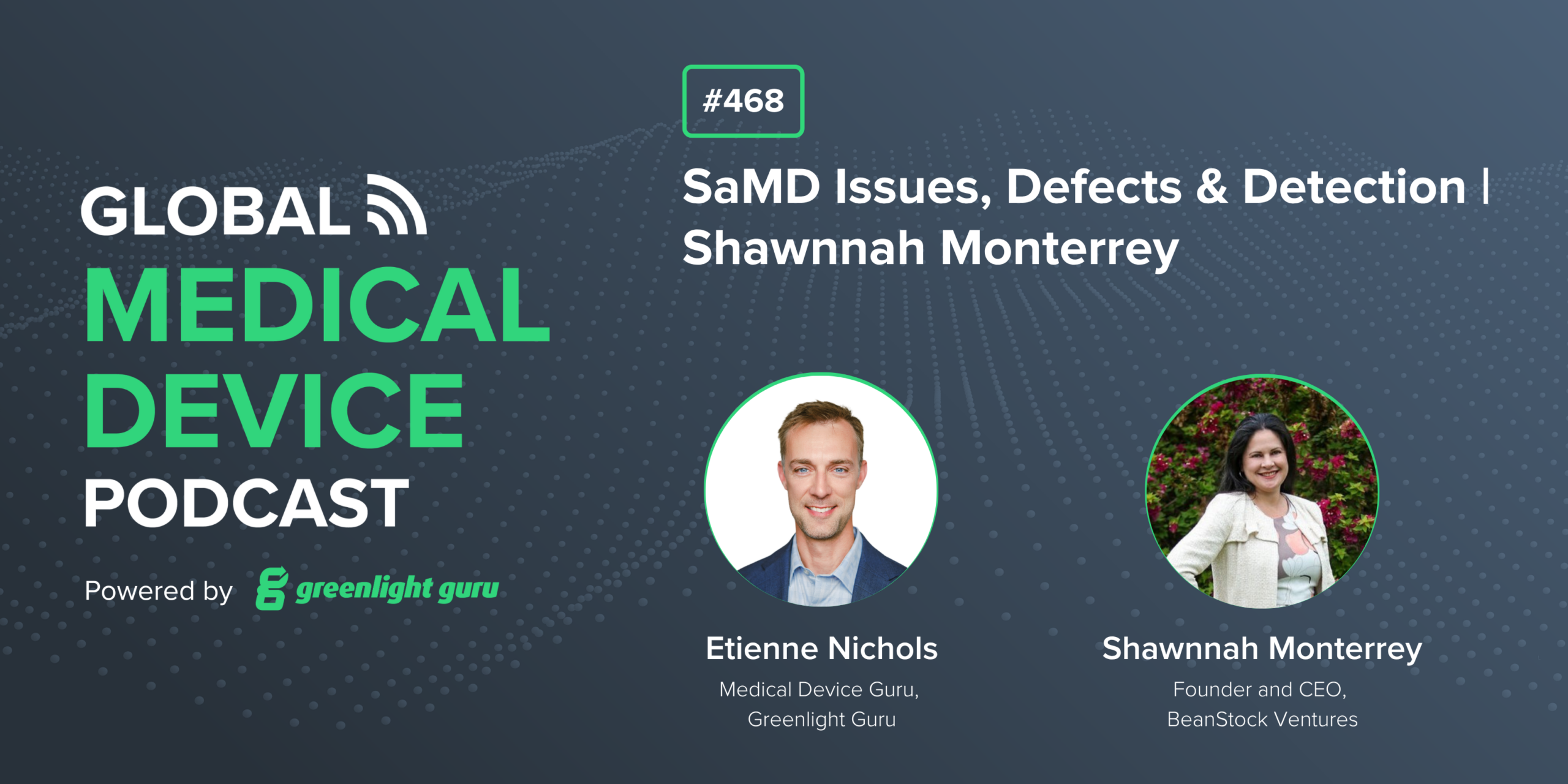
I recently discussed these topics with Etienne Nichols on the Global Medical Device Podcast, including real-world examples of software defects, manufacturing transfer, DFMEA, root-cause analysis, field upgradeability, and post-market complaints.
Listen to the full episode: SaMD Issues, Defects & Detection with Shawnnah Monterrey.
How BeanStock Ventures Can Help
BeanStock Ventures helps medical device and digital health companies identify regulatory and product-development gaps before they become expensive submission or post-market problems.
Our team supports regulatory strategy, Design History File (DHF) assessment and remediation, software verification and validation, FDA submission readiness, and 510(k) support.
Preparing for an FDA submission—or concerned about gaps in your software DHF? Contact BeanStock Ventures to discuss a submission-readiness or DHF assessment.